



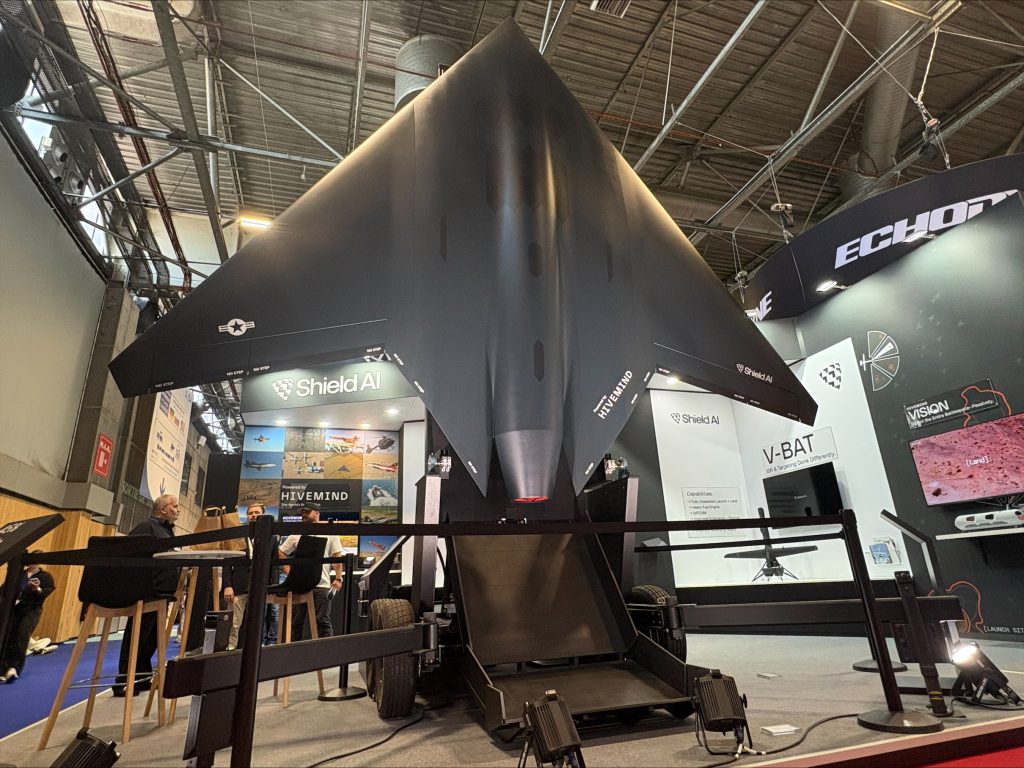
Armor Harris is the technical force behind Shield AI’s vertical take-off and landing X-Bat combat jet, leveraging experience developing SpaceX rocket boosters that land automatically.
As the global aerospace industry moves into the sixth-generation era of combat aircraft, marked by radical tailless designs and tactical fighters that fly themselves, one new jet stands as especially revolutionary.
The X-Bat prototype from American defence technology start-up Shield AI combines the latest low-observable shape and autonomous flight capabilities in an unorthodox package: a single-engined jet that takes off and lands vertically from a mobile rail system using thrust vectoring.
The idea is to provide a modern tactical fighter that can operate without fixed, well-maintained runways; a type that can be deployed to small forward bases and ship decks throughout an area of operations.
That radical concept was envisioned not by a general or defence industry executive but by an engineer who cut his teeth developing rockets for orbital launch company SpaceX.
“All credit due to Armor Harris,” Shield AI co-founder Brandon Tseng had told FlightGlobal in May.
Harris is Shield AI’s senior vice-president overseeing aircraft development programmes. Tseng describes him as the “inventor” of the X-Bat. Before joining the autonomy start-up, Harris was a propulsion engineer at SpaceX and senior director of the Starshield military satellite communications project.

A key component of the Starlink programme is the reusable Falcon 9 rocket booster, which can carry payloads into low Earth orbit and return safely to the ground, landing upright using rocket engines that can then be reused – substantially lowering the cost of launches.
Falcon 9s can land on the same pad from which they launched or at other locations like barges at sea. With the X-Bat, Harris is seeking to port that concept to the world of tactical aviation.
In a September interview, Harris described to FlightGlobal his operational vision for the X-Bat, while revealing Shield AI’s test and certification plan and why he thinks an autonomous VTOL fighter is the right tool for a pressing tactical problem facing military planners.
“We were basically trying to solve the hardest problem that we face today, which is that our primary adversary, China, can generally outproduce us,” Harris says. “The West has been investing in ever-more exquisite stealth aircraft that are survivable in the air. But what have our adversaries done? They’ve invested in a bunch of long-range missiles that hold [the stealth aircraft] vulnerable on the ground.”
“That B-2 that’s sitting on the tarmac is a lot more vulnerable on the ground than it is in the sky,” he adds.
That thesis was repeatedly confirmed in the Middle East this year when Iranian long-range missiles and drones damaged multiple US Air Force aircraft on the ground. Losses included the total destruction of one Boeing E-3 Sentry airborne warning and control jet, multiple Boeing KC-135 tankers and reparable damage to eight Boeing F-15E fighters.
Tseng says one question drove the X-Bat design: “How do you create geographically distributed long-range fires with very, very low cost per effect against an adversary like China?”
Core to X-Bat’s survivability-on-the-ground pitch is its ability to “drive away from where you landed faster than adversaries”, Harris says.
That concept has demonstrated merit in Ukraine, first with artillery crews and later with drone operators firing volleys and then rapidly evacuating to avoid counterfire. Ukraine has managed to keep its fleet of non-stealthy fighter aircraft from being destroyed on the ground by never landing where they took off.
Harris notes that keeping X-Bats from destruction on the ground could be as simple as staging their mobile launch containers on other parts of an airbase, away from runways and hangars.
“You can operate from the golf course. You can operate from just inside the fence line. You’re just staying away from the places that are going to get targeted from those incoming missiles,” he says.
Table of Contents
Radical departure or mostly conventional?
In terms of engineering, the X-Bat will likely be unlike that for any aircraft – combining a novel approach to vertical take-off and landing and a mostly experimental thrust vectoring system, all controlled by autonomous flight software without any inputs from a human pilot.
However, despite its seemingly radical appearance, Harris says much of the X-Bat’s design is fairly straightforward, taken from a conventional fighter jet.
“The design of the aircraft is actually incredibly conventional,” he says. “The propulsion train is very similar to an F-16. The structural design of the aircraft is very conventional. Everything we’re doing for [low observability] is all stuff that’s been done before.”
Like the F-16, the X-Bat will use a single GE Aerospace F110 turbofan. This will be supplemented by the Axisymmetric Vectoring Exhaust Nozzle (AVEN) system that GE developed in the 1990s to add thrust vectoring to F-16s. That system was never fielded operationally.
GE and Shield AI have already launched engine stand testing on an AVEN-equipped F110, which will use omnidirectional thrust vectoring to stabilise the X-Bat during vertical landing.

One area the X-Bat is breaking ground is in jet-powered vertical take-off and landing capability from a tail-sitting position. With that in mind, much of the test campaign will focus on that portion of flight.
“The area that we’re really wanting to science is take-off and landing in close proximity to the ground,” Harris notes. “The transition in and transition out – from horizontal to vertical – is not necessarily that concerning because there are lots of ways you can do it. It’s basically just a question of how much performance do you want to eat.”
The X-Bat trials will notably feature one piece of kit not commonly deployed for flight testing new aircraft. “We have one of the biggest cranes in the world up in Kansas at our flight-test range,” Harris says.
This will be used to test fire X-Bat prototypes while suspended, allowing Shield AI to safely refine the jet’s stability and control laws in the tricky vertical-flight orientation.
“We’ll hang the aircraft from the crane and then hover it around while it’s tethered to the crane to work out any of the kinks. We can test a lot of the different points related to the ascent/descent trajectory because we basically hang the airplane in different spots relative to the launch recovery vehicle,” Harris says. “Then we take the crane away and then do free flights after that.”
Shield AI says it plans to log the first X-Bat flight before the end of 2026, with three prototype aircraft supporting the flight-test campaign.
‘Correct number of failures’
SpaceX and its founder Elon Musk are famous for embracing the destruction of rockets during the test and development phase. Over a dozen of SpaceX’s developmental Starship vehicles have experienced “rapid unscheduled disassembly” in testing, as the company likes to say.
While the appetite for risk is high within SpaceX, it is typically considerably lower at traditional aerospace companies, where total destruction of a manned test aircraft has become rare and decidedly not worthy of celebration.
When asked which model he plans to pursue with the X-Bat, Harris says a middle path. “The way I would phrase it is: the correct number of failures in development is not zero,” he says. “If you have zero failures in development, your development took too long because you were basically too conservative.”
However, he does not expect to rack up anywhere near as many losses as the Starship programme.
“The correct number of failures is also not dozens, because then you’re just breaking stuff faster than you’re learning from it. So there’s a happy medium where you should have a couple of failures because otherwise you can’t find the true bounds until you actually push it to the limit,” Harris says.
Test plan
At the start, Shield AI will use “pretty conservative” parameters for speed and flight profile during the take-off and landing approach portions of flight, he notes. But the test team will progressively push into more aggressive speeds and trajectories “until we find a limit”.
That limit may be identified in test data and simulated environments, sparing some X-Bat prototypes rapid unscheduled disassembly. However, Harris expects the X-Bat test campaign will mark a broader shift for experimental aviation.
“The community is just so rooted in what’s been done before that people have a much-harder time breaking out of the mould than [they] do in space, because in space there are many things that just haven’t been done before yet,” he says.
Despite the X-Bat’s novel appearance, Harris says Shield AI already has significant data specific to tail-sitting vertical flight. That comes from the company’s much smaller V-Bat – a Group 3 UAV used for reconnaissance, surveillance and targeting.
The V-Bat is in use by the Ukrainian armed forces, the US Coast Guard and US Navy.

Although it uses a ducted fan instead of a jet engine, and though it weighs only 75kg (165lb) – a fraction of the Group 5 X-Bat’s weight – Harris says much of the science for unassisted VTOL flight was figured out for the V-Bat.
“When I came to Shield, basically the first thing we did was… redesign the V-Bat to be fully autonomous,” he notes. “We worked out a lot of that – things like, how does the sea look to your sensors when you’re coming in? What does the turbulence look like coming off of the wake of the superstructure of the ship? All these little lessons, we learned.”
In Harris’ estimation, the X-Bat will fall between the V-Bat and Falcon 9 rocket in terms of complexity. Although the Falcon 9 is larger and far more powerful, it only operates in a permissive environment, often using the same landing site over and over.
The rocket is also much heavier, which offers more stability against turbulent air currents or wind shear during approach. Despite its sail-like shape, the X-Bat will similarly benefit from this dynamic.
“X-Bat is actually not nearly as sensitive to the wind as V-Bat is,” Harris says. “The surface-area-to-mass ratio is so much different. Basically, X-Bat has a lot more inertia. People imagine that you have this big sail area and the aircraft coming in, but actually we’re limited just by roll control, not by pitch and yaw. So the wind envelope is actually pretty large.”

Unmanned unlocks VTOL
Vertical take-off and landing fighter jets are not new. The BAE Systems/McDonnell Douglas AV-8B Harrier series has been flying for over 40 years. The newer Lockheed Martin F-35B is in service around the globe.
But those aircraft both have a fundamental limitation: a human pilot must be able see the landing area.
Until recently, that reality precluded a tail-sitting VTOL design, which would make a piloted approach highly impracticable, if not impossible. But the rapid emergence of autonomous flight technology in the past few years has upended that conventional wisdom.
Perhaps paradoxically, that actually allows for a much simpler overall design. Unlike the Harrier or F-35B, the X-Bat has no need for pivoting thrust nozzles or heavy lift-fans.
“It’s basically a conventional airplane turned on its side,” Harris says. “If you think about the F-35B, you have that really complex big lift-fan system, [that] takes up a bunch of volume in the fuselage, eats into a bunch of your payload range.”
“This doesn’t have any of that,” he adds of the X-Bat.
Sales outlook
As critical as making the X-Bat’s engineering work will be securing orders. That will require not just the usual sales pitch but development of entirely new operational concepts.
While the US Air Force is pioneering uncrewed tactical fighters with its Collaborative Combat Aircraft programme, its FQ-42 and FQ-44 designs both use conventional wheeled landing gear. Other defence manufacturers are going after unmanned vertical flight using new rotorcraft designs, including Sikorsky’s Nomad, Beta Technologies’ MV250, the Joby S4-T and the Anduril-Archer Thunder tiltrotor.
Shield AI stands apart in pursuing uncrewed VTOL for a fixed-wing jet.
The Pentagon is supporting a large portion of the X-Bat development costs, including $50 million from the Defense Innovation Unit and a separate $150 million commitment from the US Navy in October. In total, Shield AI has raised $400 million in public and private capital to support the project.

The navy is clearly a primary target for the company, building on its existing work with the V-Bat. A rendering released by Shield AI in October shows a row of X-Bats positioned on the deck of one of the US Navy’s Expeditionary Sea Base vessels.
Unlike the US Air Force, the navy has done relatively little work to develop uncrewed combat aircraft to supplement its existing inventory of F-35s, Boeing F/A-18 Super Hornets, Boeing EA-18G Growler electronic attack jets and the still-unnamed sixth-generation F/A-XX fighter. The X-Bat could prove an attractive option, particularly as it would not require additional space on flight decks and hangar bays of conventional aircraft carriers.
Shield AI is also pursuing sales in Europe, having signed a letter of intent with Polish manufacturer WZL-2 to produce the X-Bat in Poland. A separate partnership between WZL-2, Shield AI and GE Aerospace is exploring the possibility of an F110 engine MRO site in Poland.
The company has set a goal to achieve “early operational capability” for the X-Bat by 2029, with an initial combat deployment around that time.
Flight test and sustainment for the X-Bat is based at Newton City-County airport in Kansas, while production will be housed south of Seattle in Des Moines, Washington. Prototyping activities are ongoing in Frisco, Texas.
The post From Falcon 9 to fighter jets: the former SpaceX engineer behind Shield AI’s vertical landing X-Bat first appeared on FlightGlobal.