


Dubbed the “Widowmaker” during its military career, the F-104 could now become a flying space launchpad.
An aircraft once feared for its deadly accident record is finding new purpose as a platform for testing technologies at supersonic speeds and potentially launching rockets into space.
With its slender shape, unusually small wings and powerful engine, the Lockheed F-104 Starfighter was built for speed — a supersonic interceptor designed to operate at high altitudes.
When it entered US Air Force service in 1958, the Cold War-era jet was the first US fighter capable of sustained flight at more than twice the speed of sound, earning itself the nickname “missile with a man in it”. That same year, the Starfighter became the first aircraft to simultaneously hold official records for speed, altitude and time to climb.
Nearly 70 years later, a handful of Starfighters are still flying, although their missions have changed considerably.
Florida-based Starfighters Space operates a fleet of seven F-104s – some of the last airworthy Starfighters in the world. In the past month, the company announced several agreements to use its fleet to support aerospace and hypersonic testing, while also continuing to develop a system for launching space-bound rockets from an airborne F-104.
The idea is to use the F-104 to carry a rocket high into the atmosphere before releasing it, potentially reducing the amount of propellant needed in comparison to conventional ground-based rocket launches. The approach also allows the company to leverage the advantages of using an existing aircraft rather than take years to develop expensive new rockets.
“We’re not like most other aerospace launch companies. We’re not spending billions of dollars inventing new things with a huge amount of ground equipment,” Starfighters Space chief executive Tim Franta told FlightGlobal in an interview.
However, the company’s decision to rely on an ageing fighter jet with a notoriously dangerous history does not come without risks.
Table of Contents
Fast, but dangerous
The unusual design of the F-104 Starfighter was the work of Lockheed engineer Clarence “Kelly” Johnson. At a time when fighter jets were becoming larger and more complex, Johnson decided to work against the grain, creating a small, lightweight fighter equipped with a high-thrust engine.
The result was an aircraft with short, exceptionally thin wings – each extending just 2.3m (7.5ft) from the body of the aircraft – designed to minimise drag at high speeds. The jet first flew on 4 March 1954.
But the same characteristics that made the Starfighter one of the fastest aircraft of its generation also contributed to its reputation as one of the most unforgiving.
The F-104 developed a notorious accident record, particularly while serving with the air force and navy of West Germany. Of the 916 Starfighters acquired by the country, 292 were lost in flying accidents, claiming the lives of 116 pilots.
As a result, the F-104 became known as the “Witwenmacher”, or “Widowmaker”.
Several factors contributed to the aircraft’s troubled history.
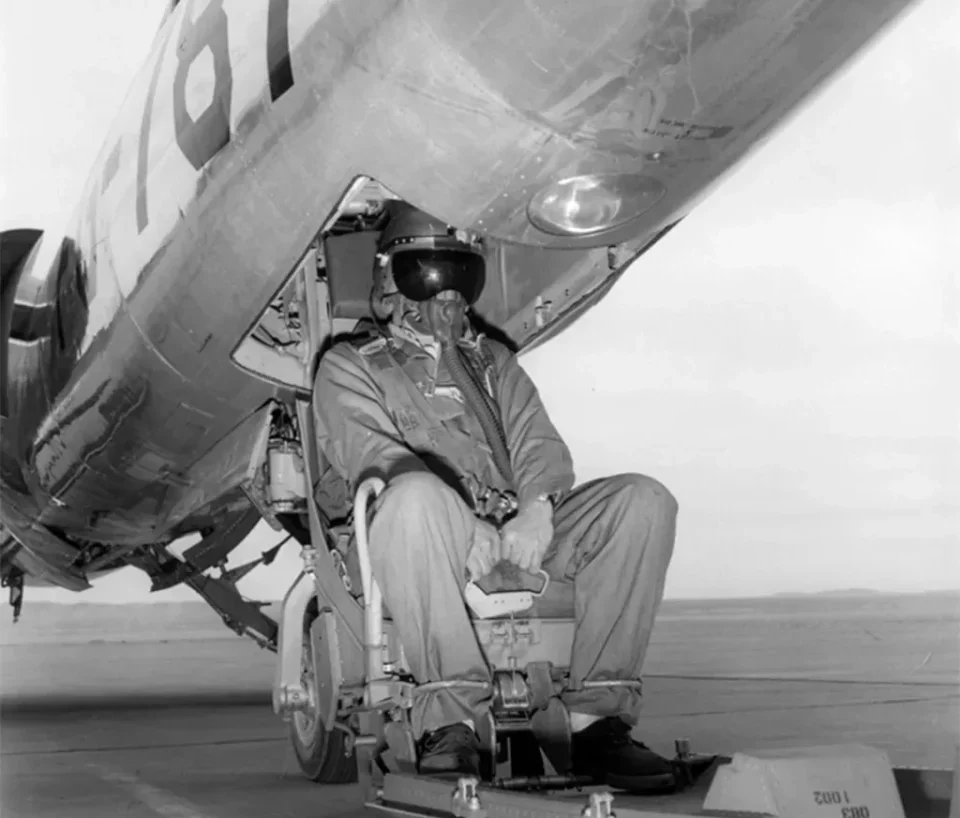
Early versions of the jet featured a downward-firing ejection seat, introduced partly because of concerns that an upward-firing seat could not safely clear the aircraft’s tall tail. However, engineers quickly realised that ejecting downwards at low altitude left pilots with too little time to deploy their parachutes.
According to US Air Force records, 21 F-104 pilots were killed in incidents involving the ejection system, and by 1960, efforts to replace the downward-firing seats with an upward-firing design were underway.

The aircraft’s small wings also presented challenges. While well suited for high-speed flight, they generated relatively little lift at lower speeds, meaning pilots had to maintain unusually high speeds during landing to keep the aircraft airborne.
Furthermore, although the F-104 was originally designed to intercept enemy aircraft at high altitudes, the West German Air Force used it for a wider range of missions, including low-level fighter-bomber operations, often in difficult weather conditions.
Flying at high speeds close to the ground left pilots little room for error, leading to numerous crashes.
Failures of the F-104’s General Electric J79 engine also contributed to the aircraft’s accident record, with its single-engine design leaving pilots without a backup source of thrust if the engine failed.
Another factor was a lack of experience among West German pilots.
According to the US Air Force, some pilots had accumulated as little as 500 flying hours before being assigned to fly the F-104. Their initial training also took place in the generally clear skies of the southwestern United States, before they returned to the often more challenging weather conditions in West Germany.
Together, these factors made an already demanding aircraft particularly difficult to operate.
West Germany withdrew the F-104 from frontline service in 1987, but continued to fly test aircraft until 1991. The US Air National Guard operated the type until 1975, while Italy kept it in service until 2004.
A second life
Today, Starfighters Space operates its aircraft from facilities at Kennedy Space Center in Florida and Midland International Air & Space Port in Texas.
According to Franta, the company’s fleet includes some of the last F-104s manufactured.
Of its seven aircraft, five were acquired from Italy – some of which had been modernised by the Italian Air Force – and the remaining two from Canada.
Starfighters Space has introduced additional upgrades to the aircraft since acquiring them, including equipping them with modern avionics and navigation systems.

Franta argues that the F-104 is easier to maintain than some more modern combat aircraft. This, he says, is due to the aircraft’s relatively simple design, which he describes as “literally an engine, a fuel tank, [and] a pilot.”
He estimates that the F-104 requires “four times less hours to maintain” than an F-15 or F-16.
But while the F-104’s straightforward design may make maintenance easier, the aircraft’s accident-prone history still raises questions about its suitability for modern operations.
When asked how Starfighters Space is addressing these concerns, Franta told FlightGlobal that unlike some of the relatively inexperienced pilots who flew the jet during its military service with West Germany, the company only employs pilots with thousands of flying hours.
He also points to the company’s safety record, saying that Starfighters Space and its predecessor, Starfighters Inc, “have operated the aircraft successfully for close to 30 years without an incident.”
Putting speed to new use
Rather than intercepting enemy bombers, one of the ways Starfighters Space is putting the F-104’s speed and altitude capabilities to use is by helping customers develop and evaluate new aerospace technologies.
According to Franta, around half of the company’s business comes from defence-related work – either directly with government customers or through major contractors – with the remaining 50% split between commercial activities (30%) and civil and academic research (20%).
Much like NASA, which used the F-104 for flight research and to test experimental technologies before retiring its last aircraft in 1994, Starfighters Space is using the ageing fighter as a flight-testing platform for its customers.
Rather than relying solely on ground-based testing, customers can attach experimental equipment beneath the F-104’s wings to evaluate how it performs during high-speed flight.
In January 2026, Starfighters reported completing three supersonic test flights for GE Aerospace’s Atmospheric Test of Launched Airbreathing System (ATLAS) programme, which aims to develop propulsion technology for high-speed aircraft and missiles.
More recently, on 10 November, Starfighters announced a partnership with Texas-based Exos Aerospace to pursue opportunities with the US Air Force to support aerospace and hypersonic testing.

Six days later, the company signed a non-binding agreement to help test the Reaver hypersonic interceptor being developed by Florida-based aerospace technology company Horizon Apogee.
Starfighters is also developing a service known as Wind Tunnel in the Sky, which would allow customers to test new aerospace technologies beneath the F-104’s wings at speeds of up to Mach 2.2 – more than twice the speed of sound.
Franta says the company hopes to conduct its first customer flight under the programme before the end of November.
From fighter jet to space launchpad
Perhaps Starfighters Space’s most ambitious project is STARLAUNCH, its programme for using the F-104 as a flying space launchpad.
Unlike conventional rocket launches, which begin on the ground, STARLAUNCH would use the F-104 to carry a rocket part of the way towards space.
The programme’s first phase, STARLAUNCH 1, aims to send small payloads – such as scientific research equipment – on suborbital missions, allowing them to reach space – but not quite enter orbit – before returning towards Earth.
Franta argues that launching rockets from an aircraft offers significant advantages, particularly when it comes to fuel consumption.
“Most rockets – despite of what they are – use almost half their fuel to get to 60,000 feet at about 600 miles an hour,” Franta says.
By comparison, Starfighters plans to release its rocket from an F-104 travelling at approximately 1,100mph at an altitude of 42,000ft. Starting at that altitude and speed could allow the company to use a smaller rocket, requiring less propellant and hardware than would otherwise be needed for a comparable mission launched from the ground.
Another potential advantage of this method, Franta says, is the flexibility it offers for the direction of launch.
Unlike a fixed rocket launch pad, an aircraft can fly to a suitable location before releasing its rocket, reducing the need for the rocket to change direction once launched.
The programme is currently approaching its final design review, with wind tunnel testing already completed.

Starfighters expects to conduct an initial flight carrying a full-scale dummy rocket beneath the F-104’s wing in early December 2026. The test will allow engineers to assess how the rocket fits beneath the aircraft and evaluate operating procedures.
If successful, the company plans to conduct a drop test to determine whether the rocket can separate cleanly from the aircraft without putting the pilot at risk – an aspect Franta says is among the primary concerns of the US Federal Aviation Administration (FAA).
Only after these tests would the company proceed towards a powered rocket launch. Starfighters has not yet announced a date for when it anticipates reaching that milestone.
Looking beyond the F-104
Despite its usefulness for high-speed testing and its potential role in rocket launches, Starfighters Space recognises that its ageing fleet cannot remain in service indefinitely.
“They do have a life expectancy,” Franta says. “The aircraft will be flown out in about 12 to 15 years.”
To prepare for that eventuality, and to pursue missions beyond the F-104’s capabilities, the company is working to acquire a second aircraft type, which it refers to as “platform two”.
This might be another Cold War icon: the McDonnell Douglas F-4 Phantom II. In 2024, the company entered an agreement to acquire 12 F-4s formerly operated by South Korea. However, Starfighters has not yet publicly confirmed whether the F-4 is designed to serve as a replacement for its F-104 fleet.
The acquisition has also run into difficulties. In an SEC filing dated 16 November 2026, Starfighters says it has been unable to obtain information from the seller, Aerovision, about the aircraft’s availability, despite repeated attempts to contact the company. On 10 August 2026, Starfighters’ subsidiary, Starfighters International, filed a lawsuit against Aerovision alleging breach of contract and other claims.
FlightGlobal contacted both Starfighters Space and Aerovision for comment, but neither responded by the time of publication.

Regardless of which aircraft is selected, Franta says it will be capable of carrying heavier payloads and will have two engines, unlike the F-104, which has only one. This could allow the aircraft to continue flying if one engine fails.
Franta says the aircraft would also provide “a little more lift” to support the company’s longer-term STARLAUNCH 2 ambitions, which involve launching payloads into low Earth orbit rather than on suborbital flights.
But while Starfighters is looking towards a new aircraft to expand its capabilities, Franta remains convinced that the F-104’s design is difficult to match.
“Nothing will replace the F-104,” Franta says, describing it as a “unique aircraft” with what he considers a “near-perfection design.”
For Starfighters Space, the challenge now is how much more it can accomplish with the iconic Cold War fighter before its remaining years run out.
The post Cold War icon gets a new life: how Starfighters Space is repurposing the infamous F-104 first appeared on FlightGlobal.