


Tuesday, November 24, 2026

Neolithic Farmers in Poland Fertilized Their Fields

KUJAWY, POLAND—Science in Poland reports that high nitrogen levels detected in the isotopic analysis of human and animal bone collagen recovered from more than 30 archaeological sites in northern Poland indicate that Neolithic farmers fertilized their fields. The study also showed that these early farmers ate little fish and other freshwater foods. Then, between around…
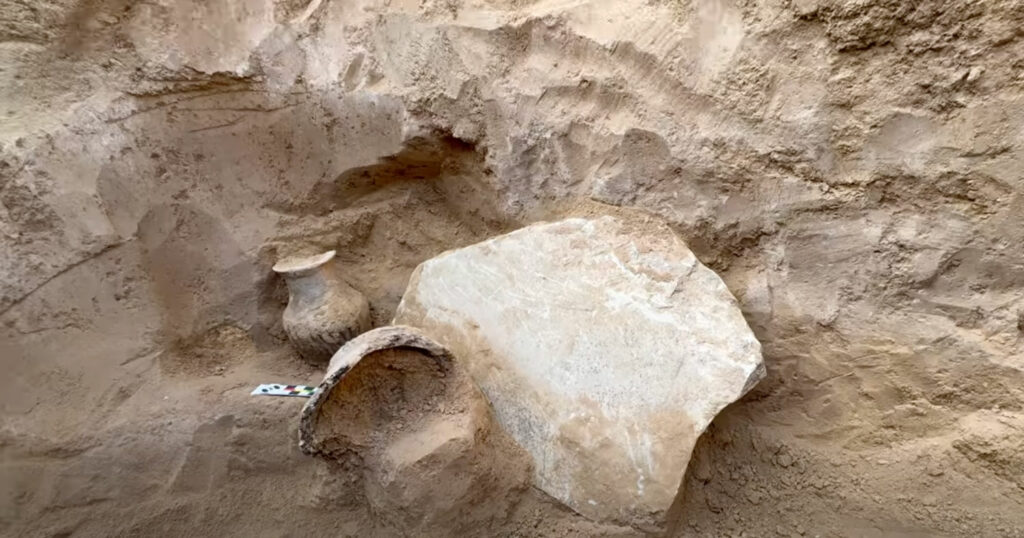
Scythian Tomb Unearthed in Moldova
Ancient Engineering

Scythian Tomb Unearthed in Moldova

Pottery and possible piece of an altar in a Scythian tomb, Gura Bacului, Moldova DNIESTER, MOLDOVA—According to a Moldpres report, a Scythian tomb dated to the third century B.C. has been discovered by archaeologists from Moldova’s National Archaeological Agency. The tomb, made up of an access shaft, a corridor, and a burial chamber, was found…

Early Gold Dental Bridge Examined

ABERDEEN, SCOTLAND—Live Science reports that a dental bridge was discovered on the lower jaw of a man whose remains were unearthed at St. Nicholas East Kirk in northeastern Scotland. The man was middle-aged when he died sometime between 1460 and 1670, said bioarchaeologist Rebecca Crozier of the University of Aberdeen. The bridge was made of…

Ceremonial Structures Investigated at Peru’s Cerro de la Horca

PARAMONGA, PERU—Andina News Agency reports that Jose Luis Fuentes of the National University of San Marcos and his colleagues have uncovered possible ceremonial structures at Cerro de la Horca, or “Gallows Hill,” an archaeological site on Peru’s central coastline that was first inhabited around A.D. 900. “There are around 20 mounds surrounding four plazas, in…

IEEE Program Aims to Connect the Billions Who Are Still Offline

Given how integral the Internet has become to everyday tasks such as shopping, paying bills, and holding virtual meetings, it’s interesting that nearly 30 percent of the global population still has no access to it. More than 2 billion people are still offline, according to a report released in November by the International Telecommunication Union.More…

Stunning fossil discovery challenges the origins of animal life

Scientists revisiting mysterious 540-million-year-old microfossils from Brazil have overturned a major idea about early animal life. What were once thought to be trails left behind by tiny worm-like creatures are now believed to be fossilized communities of bacteria and algae — some with remarkably preserved cells and organic material still intact.