
Beyond Prompting: Using Agent Skills in Data Science
How I turned my eight-year weekly visualization habit into a reusable AI workflow The post Beyond Prompting: Using Agent Skills in Data Science appeared first on Towards Data Science.

Maud Turner thought she might finally have found an explanation for the noises. After weeks of knocking in her Oxfordshire cottage, something had begun to…
Read More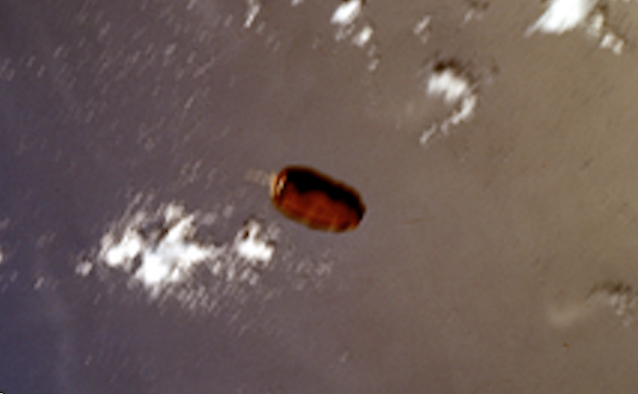
Date of discovery: Nov 24, 2026Date of event: July 18-21,1966Location of sighting: Earths OrbitSource photo 1: https://tothemoon.im-ldi.com/gallery/Gemini/10/10Source photo 2: https://tothemoon.im-ldi.com/gallery/Gemini/10/10First off, the source is an official…
Read MoreHow I turned my eight-year weekly visualization habit into a reusable AI workflow The post Beyond Prompting: Using Agent Skills in Data Science appeared first on Towards Data Science.
From missing values to schema mismatches, data issues appear in many forms. These five Python scripts provide smart, automated validation for modern data workflows.
Roboticists used to dream big but build small. They’d hope to match or exceed the extraordinary complexity of the human body, and then they’d spend their career refining robotic arms for auto plants. Aim for C-3P0; end up with the Roomba. The real ambition for many of these researchers was the robot of science fiction—one…
The handsome new book Maintenance: Of Everything, Part One, by the tech industry legend Stewart Brand, promises to be the first in a series offering “a comprehensive overview of the civilizational importance of maintenance.” One of Brand’s several biographers described him as a mainstay of both counterculture and cyberculture, and with Maintenance, Brand wants us…
This is today’s edition of The Download, our weekday newsletter that provides a daily dose of what’s going on in the world of technology. The problem with thinking you’re part Neanderthal There’s a theory that many of us have an “inner Neanderthal.” The idea is that Homo sapiens and a cousin species once bred, leaving…
Ellie’s Pi Day post: https://mitadmissions.org/blogs/entry/pi-day-2026-food-institute/ How Ellie orchestrated the baking of 30 pies: https://mitadmissions.org/blogs/entry/behind-the-scenes-of-thirty-pies/
arXiv:2604.13318v1 Announce Type: new Abstract: Autonomous web agents powered by large language models (LLMs) have shown promise in completing complex browser tasks, yet they still struggle with long-horizon workflows. A key bottleneck is the grounding gap in existing skill formulations: textual workflow skills provide natural language guidance but cannot be directly executed, while code-based skills…
arXiv:2604.13283v1 Announce Type: new Abstract: Earth Observation (EO) satellite scheduling (deciding which imaging tasks to perform and when) is a well-studied combinatorial optimization problem. Existing methods typically assume that the operational constraint model is fully specified in advance. In practice, however, constraints governing separation between observations, power budgets, and thermal limits are often embedded in…
arXiv:2604.13206v1 Announce Type: new Abstract: As Large Language Models (LLMs) are increasingly integrated into agentic workflows, their unpredictability stemming from numerical instability has emerged as a critical reliability issue. While recent studies have demonstrated the significant downstream effects of these instabilities, the root causes and underlying mechanisms remain poorly understood. In this paper, we present…
arXiv:2604.13180v1 Announce Type: new Abstract: Recent advances in agentic AI have enabled increasingly autonomous workflows, but existing systems still face substantial challenges in achieving reliable deployment in real-world scientific research. In this work, we present a safe, lightweight, and user-friendly agentic framework for the autonomous execution of well-defined scientific tasks. The framework combines an isolated…