

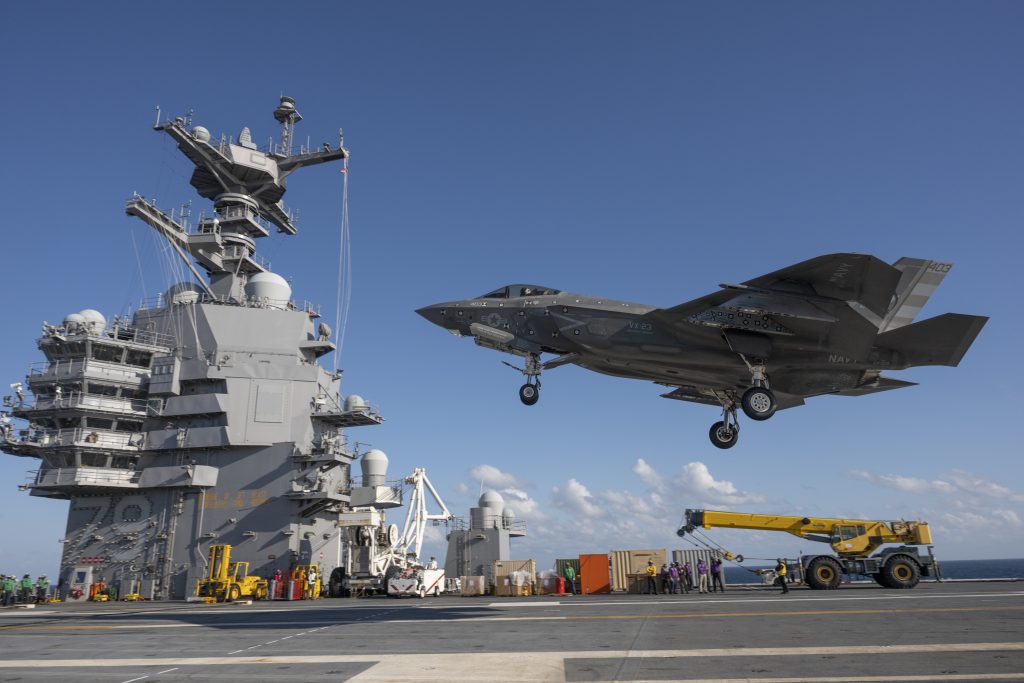
Two F-35Cs logged 122 catapult launches and arrested landings using the Electromagnetic Aircraft Launch System and Advanced Arresting Gear over 11 days of testing aboard the USS John F Kennedy.
The Lockheed Martin F-35C stealth fighter has been cleared for operations aboard the US Navy’s newest class of aircraft carriers.
A pair of the C-model F-35 carrier variants logged more than 120 arrested landings and catapult-assisted launches during at-sea flight trials aboard the USS John F Kennedy in October. The test-configured fighters from the US Navy’s Air Test and Evaluation Squadron 23 were the first F-35Cs to conduct air operations aboard one of Washington’s new Ford-class aircraft carriers.
On 19 November, Lockheed said the flight trials were successfully concluded. The company released the full summary of the evaluations and photos of the two F-35Cs operating from the flight deck of the Kennedy, which is expected to be commissioned in 2027.

Over 11 days and 34 flight missions, Lockheed says the two F-35Cs logged 122 catapult launches across using the General Atomics Electromagnetic Aircraft Launch System (EMALS). The same number of tailhook-assisted landings were also completed using the Advanced Arresting Gear (AAG) wire system, also made by General Atomics.
Individual flights incorporated multiple take-off and landing iterations.
“This is a critical event for the F‑35C, Kennedy and the United States Navy,” says Sean Jackson, vice-president, Lockheed Martin’s F-35 development programme. “For the first time, the aircraft has demonstrated launch and recovery operations from a Gerald R Ford-class flight deck, advancing the integration of fifth-generation fighter capability with the world’s most advanced carrier technology.”
Some updating required
Although Kennedy is the second Ford-class vessel, it is the first from which F-35Cs operated. The lead ship in that line, the USS Gerald R Ford, is yet unable to accommodate the single-engined strike fighter. That is due partly to exhaust heat produced by the jet’s Pratt & Whitney F135 engine, which runs hotter than the F414 engines that power the navy’s primary carrier-based fighter jet – the Boeing F/A-18E/F Super Hornet.
Several Nimitz-class carriers have been retrofitted with more robust jet blast deflectors and a specialised protective deck coating to support F-35C operations, while the newly built Kennedy received those features during construction.
Ford-class carriers will eventually replace the Nimitz-class ships, which will continue to support frontline combat operations while the class is phased in to service.
Photos of the Kennedy flight trials provided by Lockheed show the two F-35C test jets flying in a clean configuration and carrying external weapons on underwing stations.

Objectives during the 11 days of flying included verifying EMALS and AAG control software and shipboard installations, validating the F‑35C’s loads and structural models for launch and recovery, developing aircraft launch and recovery bulletins for Ford-class carriers, assessing F-35 supportability in the new carrier environment and using the new Block 4 mission systems software in a carrier environment.
“With the completion of this test phase, the navy has now cleared the F-35C for operations across its entire fleet of aircraft carriers,” Jackson says.
Electromagnetic controversy
The Ford-class features a number of significant updates compared to the Nimitz carriers, including the EMALS, AAG, electromagnetic weapons elevators and a redesigned flight deck and command island that are meant to improve flight operations by changing airflow and exhaust dynamics and the flow of deck operations.
Nearly all of those features have attracted the ire of US President Donald Trump, who has for years criticised the navy’s shift to using electromagnetically powered critical systems on the Ford-class carriers, versus steam and hydraulic equivalents on the Nimitz ships.
In August, just as the Kennedy was leaving port to begin sea qualification trials, Trump ordered the Pentagon to draw up a plan for replacing the EMALS and electromagnetic lifts on future Ford-class vessels with a steam-powered catapult and hydraulic elevators.

The president’s opposition to the new systems stems from his first term, during which the new carrier programme racked up billions of dollars in cost overruns and lengthy schedule delays related to development of the new electromagnetic catapult and lifts.
Lockheed says the EMALS offers “smoother, more-precisely controlled aircraft launches” versus steam catapults and that the AAG supports a “broader range of aircraft recovery conditions” as compared to the hydraulic wire system used on the Nimitz-class.
The electrically driven launch method can also achieve greater speeds off the flight deck with more controlled acceleration, reducing structural fatigue on aircraft and extending service life.
For now, the White House directive applies only to the fourth Ford-class carrier, which has been designated the USS Doris Miller. That ship is not scheduled to be commissioned until 2034.
The third Ford vessel — the latest ship to bear the iconic USS Enterprise name — is already far enough into construction that replacing the EMALS and weapons lifts would not be practical. It will proceed with the same layout as the Kennedy and Ford.

However, the reversion plan now appears unlikely to get off the ground.
During a confirmation hearing for Trump’s acting navy secretary, Hung Cao, on 17 November, US senators from both political parties criticised the EMALS removal plan and called for the Pentagon to proceed with the original Ford-class design.
“Returning to steam is a non-starter, and everybody needs to understand that,” said chairman of the Senate Armed Services Committee Roger Wicker, a Republican from the shipbuilding state of Mississippi.
With control of both houses of the US Congress moving to the opposition Democratic party in 2027, Trump’s plan for reverting to steam catapults is likely to face significant hurdles.
The post F-35C completes Ford-class flight trials as Congress pushes back on reversion to steam catapult first appeared on FlightGlobal.