



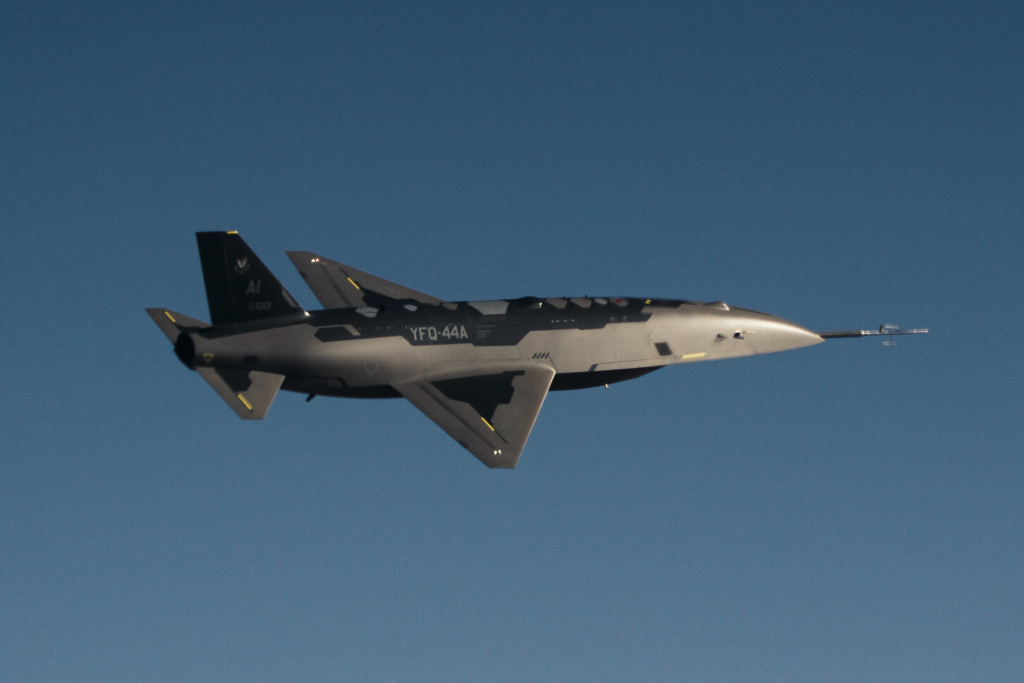
Two of the Fury jets were controlled by Shield AI’s Hivemind autonomy software.
For the first time, multiple collaborative combat aircraft (CCA) have flown together on a joint sortie.
Two Anduril Industries YFQ-44A Fury unmanned fighters – also known as CCAs – logged the milestone flight on 26 October as part of the US Air Force’s flight testing and development programme, which includes both the YFQ-44A and the General Atomics YFQ-42A Vengeance.
Although CCAs have previously flown alongside crewed fighters, this marks the first time multiple CCAs have operated together, software and aircraft developer Shield AI said on 9 November. Shield is one of two finalists to provide the artificial intelligence system that will carry out missions assigned to the new class of uncrewed fighters.
The system is officially known as Autonomy Government Reference Architecture (A-GRA).
Shield AI’s Hivemind software is being tested on the YFQ-44A, while Collins Aerospace’s Sidekick software package is paired with the YFQ-42A, although both companies say their solutions can work with either jet.
“Hivemind enabled multiple CCAs to execute a multi-ship formation and tactical beyond-visual-range air combat manoeuvres, demonstrating collaborative mission execution rather than independent aircraft simply operating in the same airspace,” Shield AI says. “These demonstrations support a model in which human pilots set the direction while mission autonomy translates that direction into coordinated action, expanding what a human-led combat team can accomplish.”
The company confirms to FlightGlobal that two Fury CCAs were involved in the 26 October sortie, which took place at the Nevada Test and Training Range near Las Vegas.
The milestone occurred just weeks after the USAF successfully paired a YFQ-44A prototype with one of its Lockheed Martin F-22 air superiority fighters in flight.
Tactical progression
The USAF intends for its first increment of CCAs to team with F-22s in an air-to-air combat support role. The A-GRA software will be an essential piece of that process, translating orders and intent from a human pilot into action amongst the CCA team.
Initially, that will be limited to air-to-air weapons employment and communicating with crewed aircraft, to include receiving instructions from human pilots flying their own aircraft and sending back sensor data. However, the scope of CCA use is expected to expand with subsequent generations of aircraft.
Separate software packages are responsible for physically flying the aircraft without direct flight control input from a human pilot or controller.

Todd Wesley, vice-president of Hivemind engineering at Shield, says the start of multi-ship flights is allowing the company to demonstrate increasingly complex scenarios and make rapid updates based on performance.
“These flights advance the complex integration of sensors, data links and interfaces that enable the mission autonomy,” he says. “Every flight gives us data that goes into the next software release. The combined Hivemind and aircraft software release process is nearing the point where the air force can fly a sortie, update the software overnight and fly again the next day.”

Autonomous expansion
While the USAF has said it plans to field 500 Increment One CCAs by 2032, it has not yet established what the mix of FQ-42s and FQ-44s will be. The service has said even less about its plans for selecting the A-GRA mission autonomy provider.
Both Hivemind and Sidekick have been flying with their assigned CCAs since February.
Hivemind is also flying on numerous other aircraft, including Shield’s tail-sitting V-Bat ISR platform and the modified Lockheed Martin F-16 known as the X-62 VISTA, which the USAF has been using to test autonomous aviation technology and tactics.
Shield also plans to field Hivemind on its forthcoming X-Bat fighter – an uncrewed, tail-sitting jet in the Group 5 UAS category that is expected to log its first flight in the coming weeks.
The post Two Anduril YFQ-44A uncrewed fighters complete first formation flight with multiple autonomous jets first appeared on FlightGlobal.